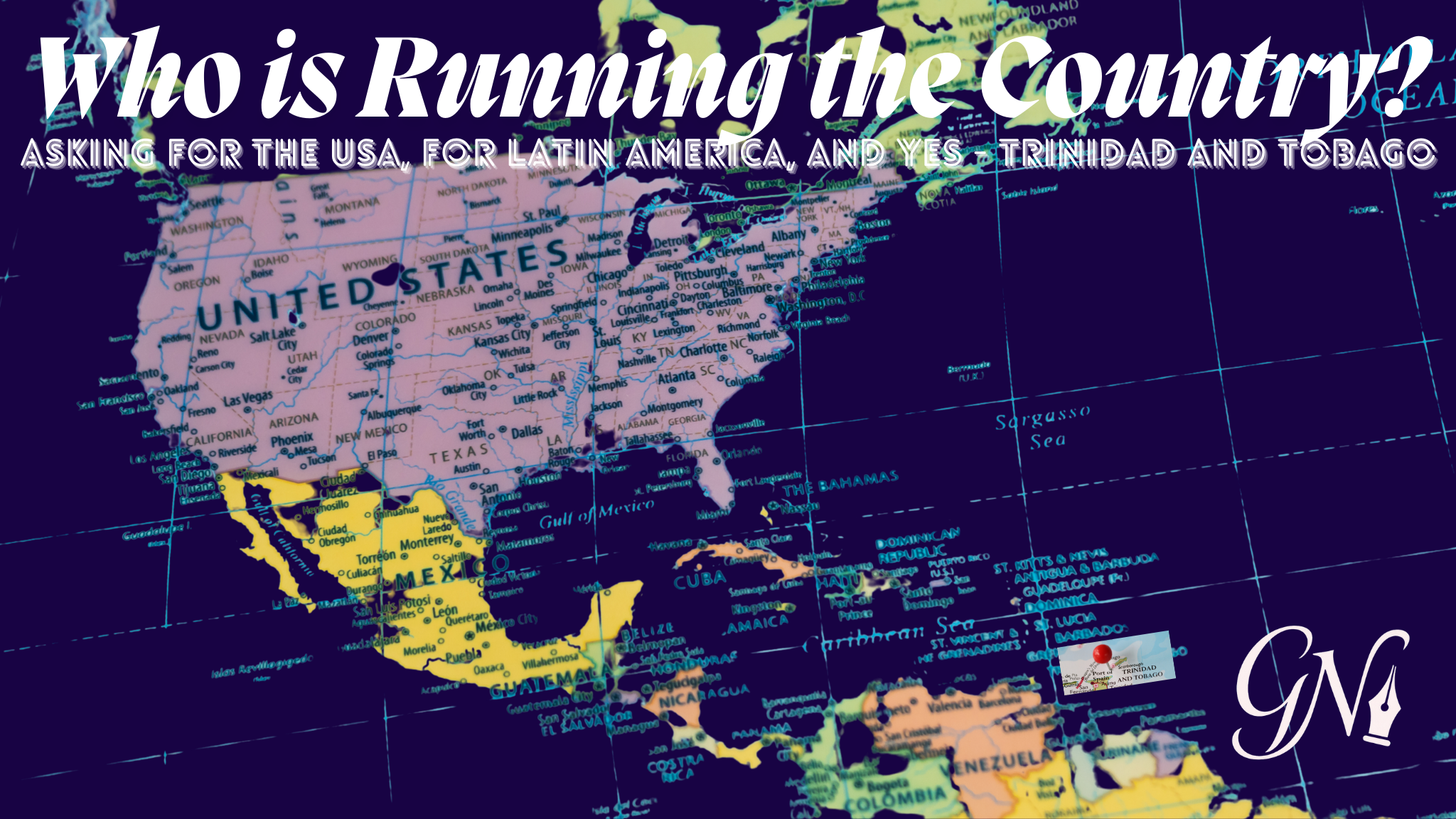
Who Is Running the Country?
Asking for the USA, for Latin America, and Yes—Trinidad and Tobago
A Grace Notes Witness from the Plebian Periphery
I write not as a constitutional scholar or a geopolitical tactician,
but as an ordinary onlooker—one of the many categorized as less adjudicated,
less powerful, less billionaire, less American—trying to make sense of what I am watching unfold.
Because there is no way, in mental jurisprudence, that the articulation of Donald Trump can stand unexamined as the headstone of American governance— not without leaving a gaping rupture where legitimacy once lived.
This is not disbelief born of ideology.
It is disorientation born of observation.
What I feel first is fracture:
a widening distance between the story America tells itself
and the machinery now operating in its name.
Since the January 2025 inauguration, I have listened carefully—not just to headlines, but to the public square. And what I have heard is not silence, nor hysteria, but accumulation.
From economists to historians, journalists to legislators, mayors to municipal leaders, the warnings have been persistent, public, and cumulative.
Economist Robert Reich has repeatedly returned to a single concern: that extreme concentration of wealth metastasizes into political dominance, hollowing democracy from the inside. Again and again, he asks whether a system can still call itself representative when outcomes increasingly reflect the priorities of billionaires rather than the needs of the governed.1
Historian Heather Cox Richardson, writing daily in Letters from an American, has offered something quieter but no less unsettling: historical memory. She reminds readers that democratic erosion rarely announces itself as crisis. More often, it arrives as normalization—through executive habit, administrative speed, and public fatigue.2
Journalist Rachel Maddow has focused less on personality than on pattern, tracing how norms are tested, then stretched, then quietly abandoned. Her work returns insistently to one question: when does precedent stop restraining power and start excusing it?3
Political commentator Joy Reid, in some of her most widely circulated recent remarks, has framed the present not as a warning of what might come, but as a reckoning with what is already here. Democracy, she suggests, does not always collapse—it can be administratively overridden while citizens are told nothing extraordinary is happening.4
On the legislative front, Bernie Sanders has carried his critique beyond Senate hearings and into public space, naming what he sees as a growing oligarchic imbalance. His repeated question—posed not rhetorically but insistently—is whether political freedom can survive when wealth is allowed to dominate governance unchecked.5
In the House, Jasmine Crockett has emerged as part of a younger congressional cohort refusing to treat oversight as ceremonial. Her public statements emphasize that hearings, investigations, and transparency are not partisan irritants, but democratic obligations—especially when executive power accelerates faster than accountability.6
Even at the municipal level, concern has surfaced. Brandon Johnson, Mayor of Chicago, has spoken openly about federal overreach and militarization, arguing that local democratic governance must not be reduced to collateral damage in national power struggles. His interventions remind me that anxiety about unchecked authority is not abstract—it is felt first in cities, in neighborhoods, in daily governance.7