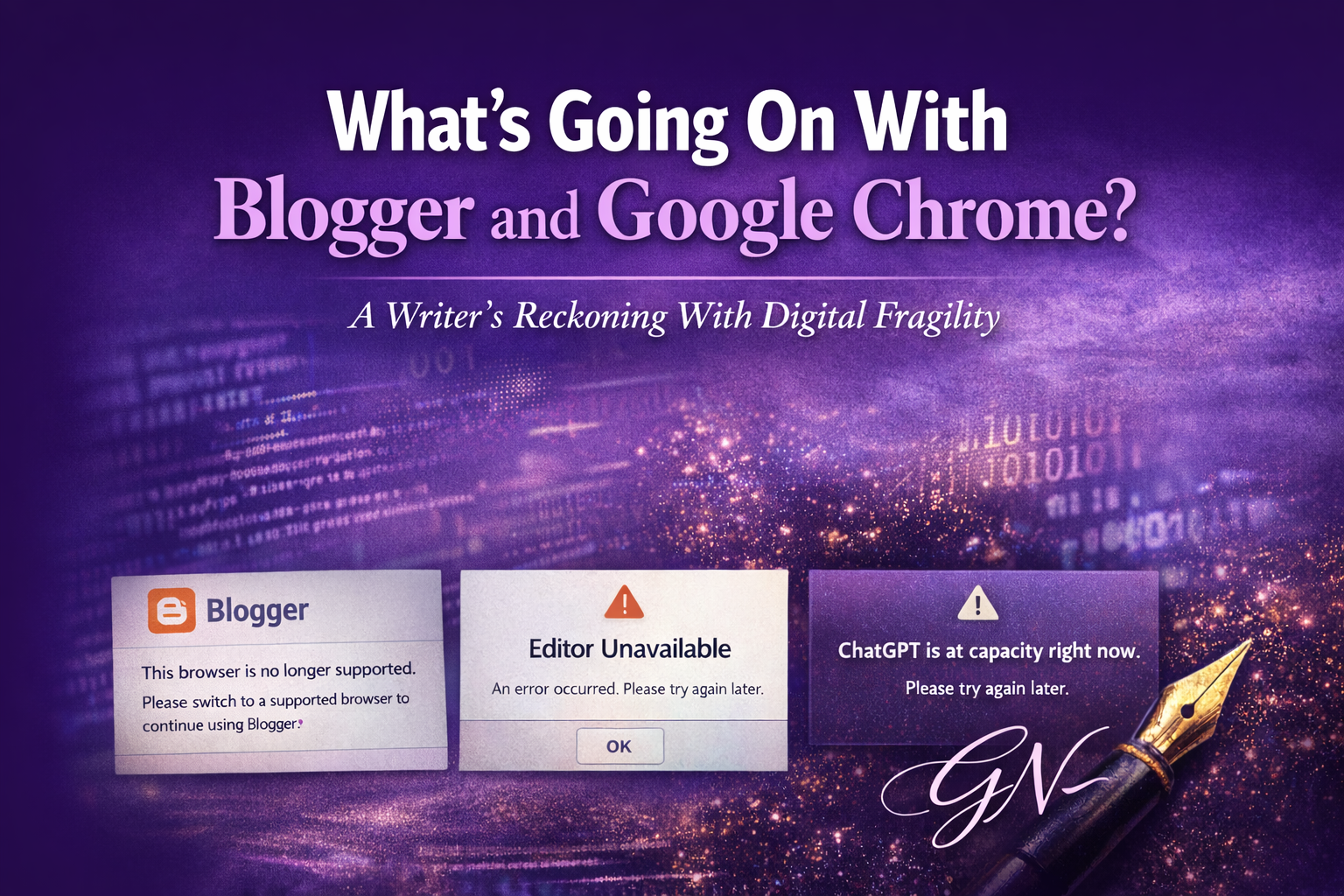
What’s going on with Blogger and Google Chrome? Someone needs to explain.
The moment the doubt arrived
When a platform that has held years of writing flashes a warning—“not supported,” “editor unavailable,” “try again later”— the fear isn’t just technical. It’s personal. It’s memory.
Evidence of disruption: a warning that interrupts trust.
Access ≠ Guarantee
Ownership ≠ Custody
Expedience ≠ Preservation
That was my immediate reaction when I opened my browser to do what I have done for years: write.
This is where—even when advanced technologies are introduced—the glitch factor becomes a serious impediment. Imagine trying your hand at writing, curating your blogs on Blogger, and instinctively opening Google Chrome as you always have, only to be confronted with a message suggesting the platform may no longer be supported.
I was aghast.
Where are my fifteen years of writing works?
Not just the polished posts—the before content. The raw drafts. The paragraphs without commas, the overused exclamation points, the half-formed thoughts that only exist because I trusted a digital portal to hold them. When that portal glitches, it is a very frightening experience.
And so I started asking questions. Looking for answers. Wondering how many others had encountered the same disruption. Because this moment reminded me—abruptly—that everything digital is not foolproof.
A second signal: the system that feels permanent is still conditional.
Unified principle
What connects Blogger, Chrome, and even AI tools is not failure—it’s conditional reliability. The message may differ, but the meaning is consistent: access is granted, not guaranteed.
How this reckoning actually began
The trigger appeared technical, but the impact was deeply personal.
For years, I had assumed that longevity implied stewardship. That because something worked reliably for a long time, it would continue to do so. That because a platform was sophisticated, it was also stable. That because the ecosystem was “the cloud,” my work was somehow safer than it would be anywhere else.
That assumption cracked open in seconds.
Nothing had disappeared.
But certainty had.
And once certainty goes, the questions rush in:
- Where does my work actually live?
- How much of my intellectual life exists only because I trusted systems I don’t control?
- If this can happen here, where else am I mistaking access for security?
When the questions become evidence
The disruption was not dramatic. That’s what makes it convincing.
Browser warnings. Editors that refuse to load. Messages that politely suggest trying again later. These are the kinds of signals that surface quietly in search results and help forums—easy to dismiss until they happen to you.
These moments don’t announce catastrophe. They introduce doubt. They show that even the most advanced platforms—blogging tools, browsers, AI-assisted environments— operate on conditional reliability.
They work extraordinarily well—until they don’t.
And when they falter, they expose the same vulnerability:
access is granted, not guaranteed.
What connects Blogger, Chrome, and AI tools
What connects Blogger, Google Chrome, and AI-driven tools is not failure, but dependency.
Each is powerful. Each improves how we write, refine, and publish. And each operates on infrastructure, updates, and priorities that sit outside the writer’s control.
The signal may vary:
- a browser warning
- an editor error
- a system message indicating capacity or disruption
But the meaning is consistent.
These tools are collaborators. They are not custodians.
Once I understood that distinction, the fear subsided—and clarity took its place.