

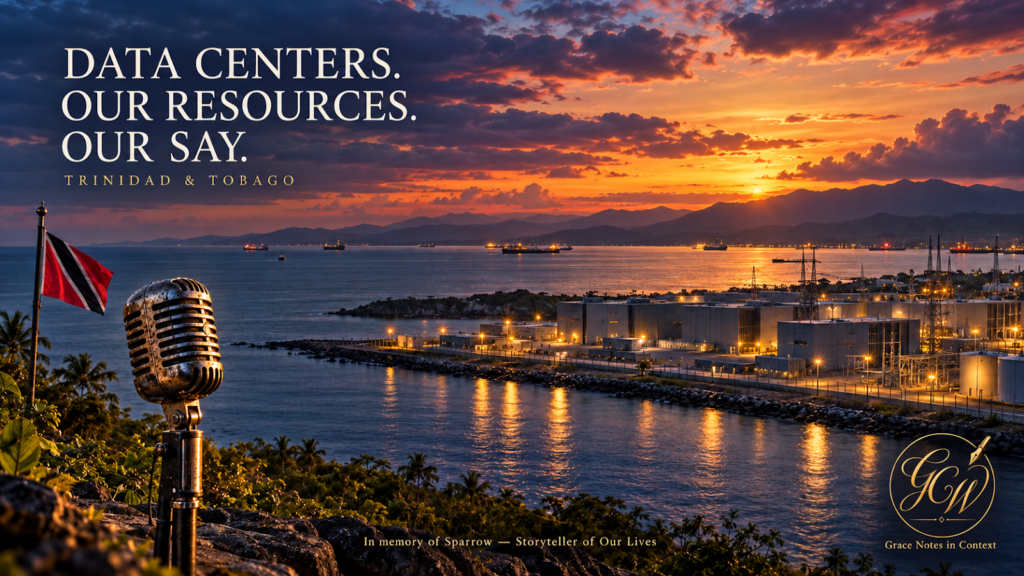
Our resources. Our say. Conceptual editorial imagery of proposed development, with a tribute to Sparrow the storyteller of our lives. Image created with AI for Grace Notes in Context; it does not depict an approved project or confirmed site.
I am not a journalist, and sometimes that may be precisely why my mind wanders before anybody tells it where it is supposed to go. I hear something, another thought attaches itself, my Trinidadian “Nancy storytelling” instincts start working overtime, and before long I have travelled halfway around the geopolitical world from a passing social-media moment. This one began in the wee hours. By the time I finished following it, I was back home asking what Trinidad and Tobago might be signing up for.
Elizabeth Booker Houston started it. She is sharp, she is biting, she defies conformity, and she tells the spectacle of politics with a guttural flourish and enough censorable language to make respectability clutch its pearls. In the video that caught me, her subject was Elon Musk’s xAI operation around Memphis, Tennessee, and the threats she described to the surrounding community. Her delivery landed the question in my head; the factual claims still needed their own receipts. [1]
Not “the cloud” floating harmlessly above us, but the physical thing beneath it: buildings, electricity, cooling, water, power infrastructure and people living around all of it. Somewhere while listening, my mind left Tennessee and came straight home. Wait nah—didn’t Trinidad and Tobago just sign MOUs for data centers too?
And Nancy started telling story. Data centers became electricity. Electricity became natural gas. Gas sent me across the water to Venezuela. Venezuela brought Delcy Rodríguez into my head, and Delcy brought me back to Kamla Persad-Bissessar. Then Mia Amor Mottley entered the picture through Barbados’s diplomacy with Venezuela. Washington, naturally, found a chair at the table. That was my thought trail. It was not yet evidence of a connection between all these developments.IN MEMORY
Sparrow, the King of Calypso,
Storyteller of Our Lives
We mourn the Mighty Sparrow, Slinger Francisco, whose passing on September 27, 2026, leaves a silence far larger than any stage. For me, his genius lives in the way he could put a nation’s business into a story, wrap the warning in wit, and have us singing before we realized how much we had been made to think. [2]
This imagined refrain is my tribute, not a lyric attributed to Sparrow:
🎶 What data centers MOU in Trinidad and Tobago will do for you? 🎶
Somewhere over my shoulder, I can almost hear him finding the chorus.
But Nancy storytelling is one thing; publishing it as fact is another. So I stopped wandering long enough to research. Where something is documented, I source it. Where I make a connection, I identify it as my interpretation. Where a thought outruns what I can authenticate, it remains a question. Nancy can open the door; she cannot write the evidence.
The megawatts deserve an explanation
Public reporting describes preliminary frameworks for two proposals: a 300 MW data center involving Ernst & Young LLP and third-party partners, and a 150 MW AI and data-center facility involving Hummingbird AI Holdings, with possible longer-term expansion of the latter to 500 MW. Together, the initial proposed capacities total 450 MW. These are proposals under MOUs, not completed facilities or proof that every necessary approval has been obtained. [3]
I am no electrical engineer, but numbers of that size deserve a public explanation. Proposed capacity is not the same as continuous consumption, and megawatts alone do not tell us annual electricity use. We need the projected operating demand, the construction phases, the source of supply and the distinction between computing load and the power needed to run the whole facility. What would be added to the grid, and who would pay?
Before the cloud, there is WASA
I know what it means when ordinary life is arranged around when water coming, when the tank filling, when to wash, cook or bathe before the pipe goes dry again. WASA’s published temporary supply schedules document that scheduled service is a real part of life in communities across our islands. [4]
So my question is ordinary enough: what is the water plan? I have not seen project-specific engineering documents that let me calculate either proposal’s water demand. Cooling choices matter, and I will not invent a gallon figure to strengthen an argument. Tell us the cooling method, the quantity and source of water, the arrangements for reuse, and whether dedicated infrastructure is proposed. Tell us who finances it, who operates it, and what happens during a shortage. The people waiting for domestic supply deserve to understand the commitments being contemplated.
Gas sends the story across the water
My mind goes from electricity to gas, and from gas to Venezuela. That is why Delcy, Kamla and Mia appear in this story: three leaders carrying different national interests around the same Caribbean neighbourhood. Their presence in my thought trail does not establish a joint data-center strategy.
Trinidad and Tobago’s energy planning has long considered domestic production and cross-border supplies. The Ministry of Energy’s published gas master plan discusses Venezuelan gas as a potential component of the country’s supply outlook; its current industry bulletins provide a place to examine production rather than rely on political enthusiasm. An older planning document is context, not a guarantee of what gas will arrive today. [5]
Reports in September describe Trinidad and Tobago’s renewed diplomatic engagement with Venezuela, including energy and trade discussions after serious strains in the relationship. Discussion is not delivery. Yesterday’s quarrel may give way to tomorrow’s necessity, but a proposed supply cannot become dependable fuel simply because a speech sounds hopeful. [6]
Mia interests me differently. Barbados and Venezuela have published a joint declaration setting out their bilateral cooperation. That is a documented diplomatic relationship, not evidence that Barbados is part of Trinidad’s data-center proposals. I watch it as a reminder that Caribbean leaders are negotiating their own national interests in a region where resources and diplomacy keep meeting. [7]
Washington enters this arithmetic too. Reuters reported September talks involving Venezuela and U.S. counterparties on energy, debt and mining. That provides context for my questions about regional bargaining; it does not prove that those talks underpin Trinidad’s MOUs. [8] What terms are being offered here? If additional gas is expected, from where, under which agreements, and on what timetable? What is the plan if anticipated supplies do not materialize?
What the Memphis dispute actually tells us
The concern that first caught my attention has a documented legal dimension. In April 2026, the NAACP brought litigation over the gas-turbine power plant in Southaven, Mississippi, associated with xAI’s Colossus 2 operation in Memphis. In May, it sought a preliminary injunction. The organizations bringing the case allege unlawful operation and harmful pollution; their filings and statements establish what they are claiming, not a final judicial finding on every claim. [9]
That geography matters: Tennessee’s data-center story includes power infrastructure across the state line. And the lesson I take home is a question, not a prediction that Trinidad will experience the same outcome. Who assesses the full footprint of a development, including its supporting infrastructure, and how early do the communities affected get a meaningful voice? Why should asking that make a Trinbagonian anti-development?
Raza Samo, Albania, and the question that travelled home
Then Raza Samo’s reel sent me to Albania. His approach, as he describes it, brings facts, news and satire to geopolitics. His commentary on Ivanka Trump and Jared Kushner’s involvement in the development controversy widened my thinking. Raza is the creator associated with the Albania post supplied for this essay; Elizabeth Booker Houston is the creator who sparked my Tennessee inquiry. [10]
Independent Reuters reporting describes protests over a Kushner-linked luxury resort planned around environmentally sensitive coastal land. That supports the underlying development-and-protest context; it does not authenticate every detail of a commentary reel. [11] Albania is not Trinidad and Tobago, and a coastal resort is not an AI data center. What connects them in my mind is citizen stewardship: when powerful interests imagine a new future for a place, what right do its people retain to scrutinize what is being committed in their name?