
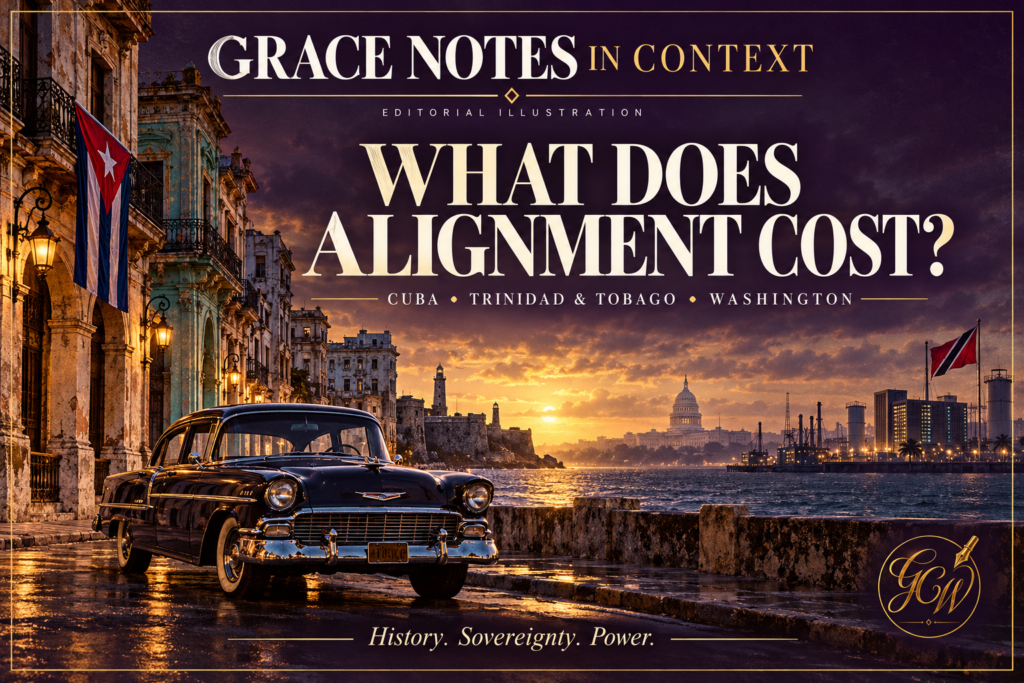
In my first post, I said I would examine Trinidad and Tobago’s vote against the United Nations resolution calling for an end to the US embargo on Cuba. The vote troubled me. But a reaction, however strongly felt, is the beginning of an inquiry.
To give my individual perspective credibility, I needed to examine the history, identify the people shaping the decisions, and distinguish what the evidence establishes from what I believe warrants further investigation.
I began with Cuba itself. Then I followed its relationship with the United States, Trinidad and Tobago’s earlier position, Prime Minister Kamla Persad-Bissessar’s changing argument, Marco Rubio’s political interests and Dr. Neil Parsan’s diplomatic role.
Are we witnessing independent decisions in Trinidad and Tobago’s national interest—or a growing dependence that makes disagreement with Washington increasingly expensive?
Cuba is a neighbour, not an abstraction
Cuba is both Caribbean and Latin American. Its history begins with Indigenous peoples, followed by Spanish conquest, slavery and successive struggles over freedom, land and sovereignty. Its Caribbean setting and Latin American identity coexist. [1]
I also bring a personal encounter to this discussion.
I visited Cuba during the Obama opening—the period in which the United States and Cuba restored diplomatic relations on July 20, 2015. That date identifies the diplomatic milestone, rather than the precise date of my visit. [2]
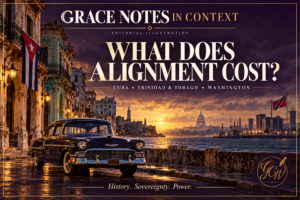
I walked through Havana. I saw the architecture, the art, the culture and the ingenuity. An old DeSoto still running, with machinery that seemed assembled from a United Nations of spare parts! That image has stayed with me: resourcefulness keeping history on the road.
But I also saw racial distinctions and deeply deteriorated housing beyond the polished visitor experience. Those were my observations; one visit did not give me a complete account of Cuban society.
The beauty did not erase the hardship. The hardship did not erase the dignity.
Even the proximity gives me pause. Havana is just over an hour’s direct flight from Nassau, according to Bahamasair. Cuba belongs to our Caribbean neighbourhood, however distant political arguments sometimes make it seem. [3]
Before communism, there was a struggle over sovereignty
To understand the relationship, I had to ask more than, “Why does America oppose communism?” I also had to ask: How did Washington come to expect a decisive say in Cuba’s affairs?
American commercial influence preceded military occupation. In 1894, nearly 90 percent of Cuba’s exports went to the United States. Sugar and access to the American market tied Cuba’s economy to its powerful neighbour while Spain still held colonial authority. [4]
Cubans were already fighting for independence when the United States entered the war against Spain in 1898. Spain’s defeat ended its sovereignty over Cuba, but American occupation followed. [5]
Washington withdrew in 1902 after requiring Cuba to accept the Platt Amendment framework, permitting US intervention under stated conditions and restricting Cuban dealings with other powers. The National Archives describes the arrangement as virtually making Cuba a US protectorate. [6]
The formal intervention framework ended in 1934, although the Guantánamo naval-base arrangements remained. That legal change matters: American authority did not remain identical across the decades. [7]
Cuban suspicion of outside control therefore has a documented foundation. That does not prove that every later American concern was invented.
Revolution, pressure and the rights of Cubans
Batista’s 1952 coup interrupted Cuba’s constitutional order. The revolution that defeated him in 1959 arose against dictatorship. Opposition to Batista should not automatically be interpreted as consent to the system that followed. [8]
Washington initially recognised the new government. Relations deteriorated over reforms, nationalisation, American property and Cuba’s Soviet relationship. The failed CIA-backed Bay of Pigs invasion in 1961 and subsequent destabilisation efforts supplied concrete grounds for Cuban fears of intervention. Soviet alignment, in turn, heightened American security concerns. [2] [9]
An April 1960 State Department memorandum proposed economic hardship as a means of undermining Castro’s support. It documents an early coercive rationale; it does not establish an identical motive for every subsequent administration. [10]
Cuba’s 1961 literacy campaign belongs in this history. So do the 2019 Constitution’s declaration that socialism is irrevocable and its designation of the Communist Party as the leading force of society and the state. Social achievement and political freedom are separate measures of government. [11] [12]
A country’s right to resist foreign domination does not extinguish its citizens’ right to challenge their own government. Condemning repression does not, by itself, establish that an embargo is the right remedy.
What T&T asserted in 1972
On December 8, 1972, Trinidad and Tobago, Barbados, Guyana and Jamaica established diplomatic relations with Cuba.
These governments did not have to adopt Cuba’s political system to recognise its place in the region. Their action asserted independent Caribbean judgment. A contemporary American memorandum records Washington’s unsuccessful efforts to discourage the decision. [13]
That history supplies a benchmark for examining today’s government. Independence includes the right to cooperate with Washington. It also requires retaining the ability to disagree.
Kamla’s 2015 position—and the question of what changed
There is a revealing comparison within Persad-Bissessar’s own record.
In April 2015, she welcomed the Obama–Castro meeting, recalled T&T’s advocacy for ending Cuba’s isolation and the embargo, credited Eric Williams and successive administrations, and praised engagement. Her conclusion included the words “diplomacy works.” [14]
Obama likewise called on Congress to lift the embargo. Restoring diplomatic relations did not itself repeal it. [15]
In October 2026, her government opposed the UN resolution calling for an end to the embargo. Local reporting identifies this as a departure from T&T’s support in successive years following its initial 1992 abstention. [16]
A government can revise its judgment. But what changed in her assessment of engagement, and what evidence now supports economic pressure?
The stated principle—and the unanswered policy question
Persad-Bissessar defended the vote through democracy, human rights and Cubans’ right to elect their government. She expressly endorsed Rubio’s position on political reform. That is the government’s stated rationale and must be represented fairly. [17]
I hear the principle. My question concerns the instrument: How does maintaining the embargo deliver those freedoms, and who bears the cost while the promised transformation remains unrealised?
Opposition to the embargo is not automatically approval of Cuba’s government.
Regional reactions demonstrate different judgments. Barbados’ CARICOM Ambassador David Comissiong expressed disappointment with other regional positions. Barbados and six other CARICOM members supported the resolution; Jamaica, Guyana and Haiti abstained, while T&T opposed it. [18]
An abstention and an opposing vote are different choices. Each government must account for its own.
Marco Rubio: conviction, constituency and power
Rubio’s relationship to Cuba is political as well as personal. His parents emigrated in 1956, before Castro’s revolution, as Rubio stated at his confirmation hearing. They should not casually be described as having initially fled Castro. [19]
His major political turnaround concerns Trump: from rival in the 2016 presidential contest to supporter and secretary of state. His opposition to Cuba’s communist government has been comparatively consistent. His appointment gave him executive authority to pursue positions he had advocated before joining the administration. [20]
My political inference is that a transformation in Cuba could validate his longstanding pressure argument and appeal to anti-communist constituencies within his political base. That is a potential incentive, not proof that personal ambition overrides conviction. Cuban-American communities themselves should not be treated as politically uniform.
The question is what happens when a politician’s established convictions meet the authority of a powerful state—and neighbouring countries are asked to support the resulting policy.
What America wants includes economics
We should examine the whole agenda.
The administration’s June 2025 Cuba memorandum explicitly identifies US national-security and foreign-policy interests, private enterprise outside government control, restrictions on military-linked revenue and opposition to international efforts to remove the embargo. T&T’s vote can be compared directly with that published diplomatic objective. [21]
The economic objective is also written into law. Under the Helms-Burton framework, criteria for a qualifying democratically elected Cuban government include movement toward a market-oriented economy and progress on returning confiscated American property or providing compensation. [22]
Washington’s desired outcome therefore includes economic restructuring and property settlements as well as political rights.
A Cuba more open to private capital and less aligned with American adversaries could provide commercial and strategic benefits. These are reasonable inferences from stated objectives—not evidence of a concealed plan to acquire the country.
- The Private Dispatch with GraceNotes: November 2026 — Before We Blink
 Before We Blink… A season of promise, connection and gratitude. Truth be told, I am all over the place. Keeping up with social media, following my interests, saving, sharing, downloading—and creating my own AI videos—has become my unpaid job on the go. Lord, please send my rewards before I get to heaven! November 3rd and… Read more: The Private Dispatch with GraceNotes: November 2026 — Before We Blink
- Symbiotic Kinetic Chemistry: The Enduring Bond of Mother and Child
 In a moment of witness, I find myself humbled. There are experiences that bring us close to the limits of our understanding. We can repeat a diagnosis. Describe the change in someone’s circumstances. Explain who needs care and where that care is being given. But how do we account for the magnitude of the connection… Read more: Symbiotic Kinetic Chemistry: The Enduring Bond of Mother and Child
- Will Hakeem Jeffries Become Speaker or Could His Record Derail His Path to the Gavel? And What About Schumer?
 Initially, I wrote this post as a novice, still finding my footing, unsure which argument deserved my bark or my bite. I wanted room to think before aligning myself with anyone’s opinion, perspective or rationale. So I let the post sit and marinate. Gave it breathing room while I kept reading, listening and trying to… Read more: Will Hakeem Jeffries Become Speaker or Could His Record Derail His Path to the Gavel? And What About Schumer?
- There Must Still Be a Line — Thank You for Your Service, Soldier
 Watching that soldier call for silence at the Tomb of the Unknown Soldier, something settled in my thoughts. The soldier maintained his decorum. He required the same of those before him. On Veterans Day, November 11, 2026, Pete Hegseth’s group was corrected after laughter near the Tomb. Reporting does not establish who laughed or whether… Read more: There Must Still Be a Line — Thank You for Your Service, Soldier
- US Citizen Dawn Michelle Hunt Remains Jailed in China: A Cause for Humanitarian Appeal
 US Citizen Dawn Michelle Hunt Remains Jailed in China: A Cause for Humanitarian Appeal An international plea for attention, compassion, and sustained action. By Grace C. Walker • November 12, 2026 • Commentary and humanitarian appeal An American woman remains imprisoned in China. Her family continues to seek her humanitarian release. And I keep coming… Read more: US Citizen Dawn Michelle Hunt Remains Jailed in China: A Cause for Humanitarian Appeal