
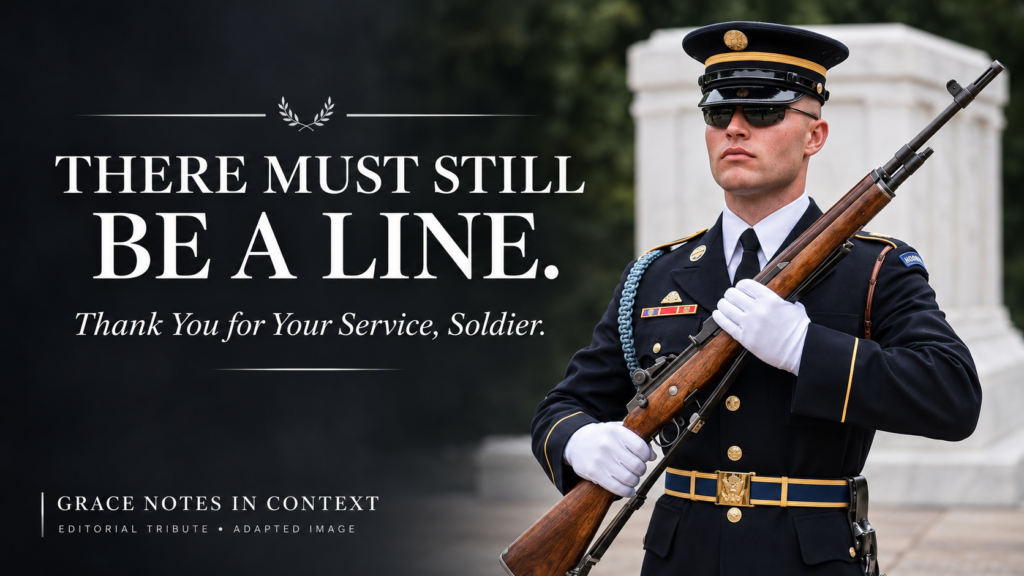
Watching that soldier call for silence at the Tomb of the Unknown Soldier, something settled in my thoughts.
The soldier maintained his decorum. He required the same of those before him.
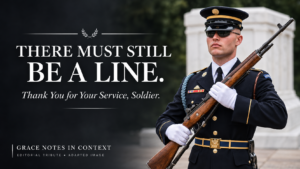
On Veterans Day, November 11, 2026, Pete Hegseth’s group was corrected after laughter near the Tomb. Reporting does not establish who laughed or whether Hegseth made noise. The sentinel commanded: [1]
“All visitors will maintain an atmosphere of silence and respect at all times.”
ALL VISITORS.
Rank, prominence and political connections do not excuse anyone from the respect expected in that sacred place.
Arlington’s own visitor guidance asks people to speak quietly and remember that this is an active cemetery, where families grieve and visitors reflect. [2]
To me, the force of that moment was its simplicity. A soldier doing his duty made the standard audible. There was no exception announced for anyone’s office.
The question Congress had already faced
One day earlier, on November 10, the House voted 211–204 to refer Republican Congressman Thomas Massie’s impeachment resolution against Hegseth to the Judiciary Committee. That stopped an immediate decision on the articles. Hegseth was not impeached. [3]
The resolution concerned separate allegations about his conduct in office. It preceded the Arlington incident.
Yet I find myself considering those moments together. Congress was confronted with a formal demand for accountability. At Arlington, a soldier enforced the standard immediately before him.
A reprimand at a memorial cannot establish the allegations behind an impeachment effort. Equally, surviving a procedural vote cannot answer every question about a public official’s conduct.
Why my thoughts returned to Vivek
My mind went back to Vivek Ramaswamy’s campaign using Amy Acton’s estranged mother in an advertisement against her. The deeply personal attack drew criticism from Republicans as well as Democrats. [4]
That reaction stayed with me. People were willing to object even when the campaign being challenged belonged to their own political side. The advertisement was subsequently pulled. [5]
I cannot say that one advertisement determined an election. What I recognize is the boundary people were willing to defend: a painful family history should not become fair game simply because someone sees political advantage in exploiting it.
Different events. Different consequences. But the thread running through my thoughts is our willingness to insist upon a standard.
How much do we excuse? How often do we surrender our judgment to party loyalty? And when someone says that the standard applies to everyone, will we stand behind them?
NOVEMBER 12 UPDATE: THE SENTINEL WAS RECOGNIZED
ABC News reports that Hegseth awarded Spc. Thomas Iglesias the Joint Service Commendation Medal on November 12. That development belongs in this account: the reported response was recognition of the soldier. [6]
We honor that sentinel for performing his duty. The Pentagon had already publicly endorsed the correction. [1] I welcome the recognition. My expectation remains that a service member should be able to uphold the rules without fear of retaliation.
Now let America’s tolerance be tested by what comes next for Hegseth
Will the demand for accountability survive beyond the headlines? Will Congress examine his conduct with the seriousness the office requires? Will Americans expect their representatives to pursue the evidence when doing so becomes politically inconvenient?
The medal is a welcome development. The separate questions about leadership and congressional oversight still require their own answers.
Blue, red and everything between—surely our tolerance must have a boundary. Surely public office must carry obligations that political loyalty cannot erase.
Power must still answer to something.
At the Tomb of the Unknown Soldier, the instruction was clear.
Silence. Respect. All visitors.
Thank you for your service, Soldier.