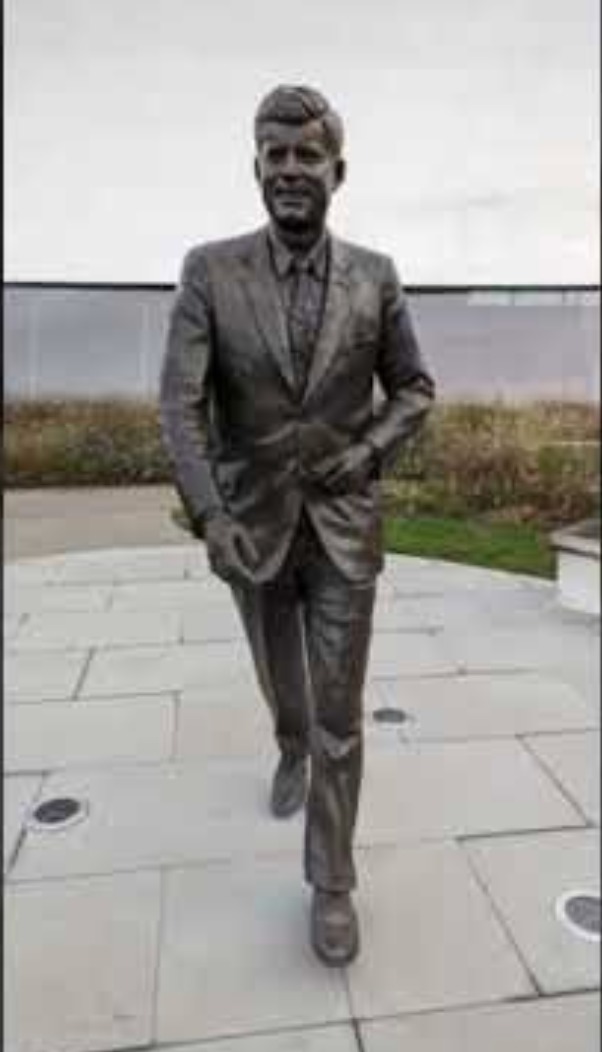
PRESIDENT TRUMP AND THE GHOST
This Hallowed Fantasy to Be Named on the John F. Kennedy Center for the Performing Arts
Marc Bamuthi Joseph reflects on the John F. Kennedy Center for the Performing Arts, art, memory and the institutional changes that followed the Center’s leadership transition.
LET’S SET THE STAGE
Here is a rigorous, poetic and deeply interpretive voice — an artist speaking not from the sidelines, but as someone who worked within and benefited from the legacy of the John F. Kennedy Center for the Performing Arts.
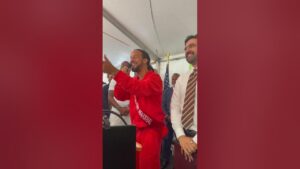
His name is Marc Bamuthi Joseph, former Vice President and Artistic Director of Social Impact at the Kennedy Center. He speaks about his departure and that of his Social Impact team following the executive and board upheaval at the institution. But listen beyond the circumstances of his dismissal, because Joseph is doing something considerably more profound here. He is describing what an institution dedicated to art can mean to the people who create within it, the communities invited into it and the audiences who gather there.
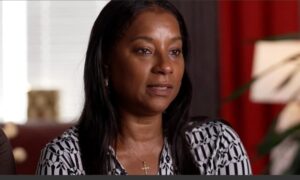
Between Congresswoman Joyce Beatty, Joseph, the performers who have raised their voices, former employees, patrons, underwriters and generations of audiences who have entered those theaters, there is something larger than solidarity. There is memory. There is the public’s cultural inheritance. And there is the enduring presence of the John F. Kennedy name and legacy upon an institution Congress established as his living memorial.
Joseph does not come before us with a legal brief, congressional testimony or judicial opinion. He comes with the poetry of lived experience. He describes those rare moments inside a theater when the right note is struck and suddenly strangers experience something together — what he memorably calls the “acceleration of the molecules in the room.”
What an extraordinary way to explain what art can do.
And then comes the sentence that, for me, carries the intellectual weight of his entire reflection:
“Art holds memory, and also horizon.”
And this is where my own examination begins.
WHAT EXACTLY ARE WE WATCHING?
Here, one voice announces what I believe has become a much larger collective and cerebral question. How does the head of supposedly the most powerful, most recognizable and certainly one of the most scrutinized nations in the world become so publicly consumed with a performing arts institution and, particularly, with the name that institution carries?
I recently heard Vice President JD Vance invoke “common sense” as part of the political language used to describe this administration, and those words stayed with me because I am trying to locate the common sense in the spectacle unfolding around this national cultural memorial.
Listen carefully to Joseph. He does not begin with political theory. He begins with experience. He tells us what his team did — free community programming, creative equity and work examining the social impact of art — and then describes what happened when leadership changed. From there he moves beyond employment, beyond politics and beyond himself to remind us that the Kennedy Center is not merely marble, concrete, stages and seats along the Potomac.
It is a living memorial.
That distinction matters.
John F. Kennedy represented, among other things, an American imagination capable of looking toward something that had not yet been accomplished and saying that the nation would attempt it anyway. The moon was not merely a destination; it became a symbol of national aspiration toward something whose technical path had not yet been completely solved.
And from the historical memory surrounding Kennedy came a performing arts center bearing his name — a place where music, theater, dance, literature and human creativity could attempt their own versions of the seemingly impossible.
THE NAME, THE MEMORIAL AND THE LAW
Now look at the controversy surrounding that memorial.
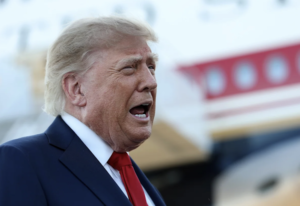
The Kennedy Center’s board attempted to add Donald Trump’s name to the institution. Congresswoman Joyce Beatty challenged that action in federal court. On May 29, 2026, the United States District Court for the District of Columbia declared that Congress named the John F. Kennedy Center for the Performing Arts for President Kennedy by federal statute and that the Center could not officially be named for anyone else without an Act of Congress. The court ordered Trump’s name removed from the façade, website and official materials. The United States Court of Appeals for the District of Columbia Circuit subsequently declined to stay that order while the appeal proceeded.
In September, the district court again confronted proposals to place Trump’s name or memorial inscriptions on the Center. The court reiterated that the governing statute reserves the Center’s public spaces as the memorial to President Kennedy and prevents the Board from unilaterally establishing another presidential memorial there.
Those are not imagined circumstances. They are part of the public judicial record.
President Trump and his allies have offered their own explanation. They argue that his administration and fundraising efforts have been essential to financing and restoring an institution they describe as financially and physically troubled. That argument also belongs in the record. The dispute, however, has moved well beyond whether someone deserves recognition for fundraising or renovation. It has become a legal and cultural confrontation over the identity of a national memorial.
PRESIDENT TRUMP AND THE GHOST
And so I dare to say this in my own voice: Trump does not stand next to Kennedy merely because Trump wants his name to stand next to Kennedy’s on a building.
That is my observation about the difference between placing a name and inheriting a legacy. A façade cannot manufacture historical equivalence. Political authority cannot decree historical stature. Those judgments emerge over decades and generations from what people remember, what institutions preserve and what history ultimately records.
That is why I call this President Trump and the Ghost.
The ghost I am speaking of is not some supernatural apparition wandering through the Kennedy Center. The ghost is historical memory.
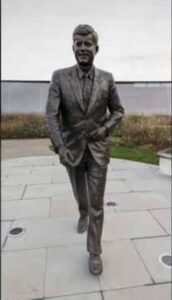
John Fitzgerald Kennedy is already there in the name, in the federal statute, in the architecture, in the artists, in the audiences and in more than half a century of performances and collective cultural memory. His assassination is part of the reason that institution became his living memorial. His presidency, with all the complexities that history properly examines rather than romanticizes, remains connected to an era when an American president publicly challenged the nation to imagine what seemed almost impossible.
That is the ghost no contemporary president can simply rename.