
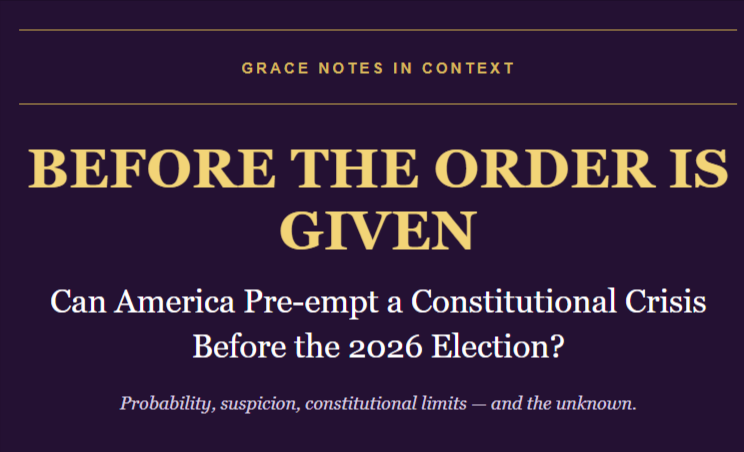
Let me establish something from the outset. What you have just watched is the verified news report that caused me to stop, go back, listen again and begin asking the questions that follow. This is no forensic analysis, nor am I attempting to impart some scholarly constitutional thesis. I am not a political scientist, intelligence analyst or investigative journalist, and I certainly claim no magical intuition that allows me to see around corners into some predetermined November outcome. I have no interest either in entering that dangerous territory of the internet where suspicion, repeated and amplified often enough, eventually gets dressed up and presented as fact. What I am doing is considerably more ordinary. I saw something, it stopped me, I listened again, and I wanted to understand what I was hearing and what, if anything, it could mean.
The video that caused that pause is real. I am not looking at some artificially manufactured news piece, some AI-generated fabrication or a cleverly spliced internet production masquerading as journalism. The clip comes from CNN’s The Lead with Jake Tapper, broadcast September 24, 2026. CNN was reporting on an investigation by The Atlantic concerning several people outside the White House advocating extraordinary federal intervention in the November midterm elections. Among them was attorney Peter Ticktin, who reportedly discussed the possibility of President Trump declaring martial law on or around Election Day. [1]
Just as importantly, CNN reported the White House position that Ticktin, Tina Peters and radio host Wayne Allyn Root have no role in White House election policy. That qualification matters and must remain part of the story. But so does what surrounded it. CNN replayed President Trump’s earlier remarks that Republicans should “take over the voting” and “nationalize the voting” in at least 15 places. The broadcast also revisited an August conversation in which Wayne Allyn Root suggested declaring a national-security emergency concerning elections. Trump did not announce that he intended to do so; his response was that “stranger things have happened.” [1]
None of those things, separately or collectively, proves that martial law is coming, that there is some secret Election Day operation already underway, or that the most alarming interpretation of these conversations is the correct one. That would be precisely the leap I am trying not to make.
For the ordinary internet-surfing citizen like myself, media oversaturation has become so normal that sometimes a telling and crucial piece of news can pass directly in front of us and still go under the radar.
We scroll through wars, politics, crime, catastrophe, scandal, breaking news, corrections to breaking news, reels, commentary and outrage, only for another notification to arrive before we have properly digested the last one. Then every so often comes what I can only describe as a comma, full stop, exclamation-point jolt — something that interrupts the scrolling mind and says, wait a minute, go back, listen to that again.
This was one of those moments for me. When a verified national news broadcast begins discussing martial law, federal control of voting, outside advocates encouraging extraordinary presidential intervention and the possibilities surrounding an American Election Day, I do not need to believe that any of it is destined to happen to believe that it deserves my attention. Quite the opposite. It is because I do not know what will happen that I find the conversation worth having.
My rhetoric here therefore places me exactly where I belong: as a curious observer, without a dossier of secret findings, without forensic analytics and without some insider briefing that gives me privileged knowledge about what anyone intends to do. I am looking instead at what has actually been said, what has actually been reported, what American history tells us has happened before, and what the Constitution and the institutions constructed around it are supposed to prevent. Somewhere between those known points sits the territory that interests me — the territory of possibility, suspicion, probability and, above all, the unknown.
THE MACHINERY AROUND PRESIDENTIAL POWER
I have thought considerably about the tendency to make Donald Trump himself the entirety of this conversation. His words and actions obviously matter because he occupies the presidency and exercises its enormous authority. But presidential power has never been simply one human being sitting behind one desk. There is machinery around power. There are lawyers developing theories of authority, advisers constructing strategies, political organizations exerting pressure, wealthy supporters financing causes, government departments possessing enormous institutional capacity, and outside advocates who may hold no government position whatsoever but nevertheless seek to influence those who do.
That distinction becomes especially important here because the White House expressly says the individuals discussed in the CNN report do not determine its election policy. We cannot erase that fact simply because their proposals are alarming. At the same time, their absence from an official White House organizational chart does not render the ideas themselves irrelevant. It leaves me instead wondering how ideas that begin outside government sometimes travel toward those who exercise government power, and how the public would recognize the moment when advocacy crossed the threshold into actual policy. In this instance, we simply do not know that it has. That is not a conclusion to be filled with speculation; it is the present boundary of the evidence.
This is where I have to discipline my own thinking, because possibility is not probability, suspicion is not evidence, political rhetoric is not an executive order, and even an executive order is not rendered constitutional merely because a President signs his name to it. Yet the opposite proposition matters too. The unknown does not suddenly become conspiracy theory simply because citizens are willing to examine it. There has to remain some responsible ground between dismissing every uncomfortable possibility as hysteria and declaring every disturbing possibility inevitable. That uncomfortable middle ground is where I am standing.