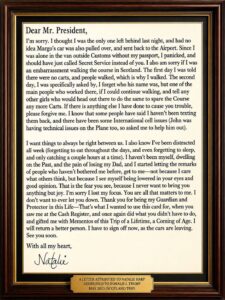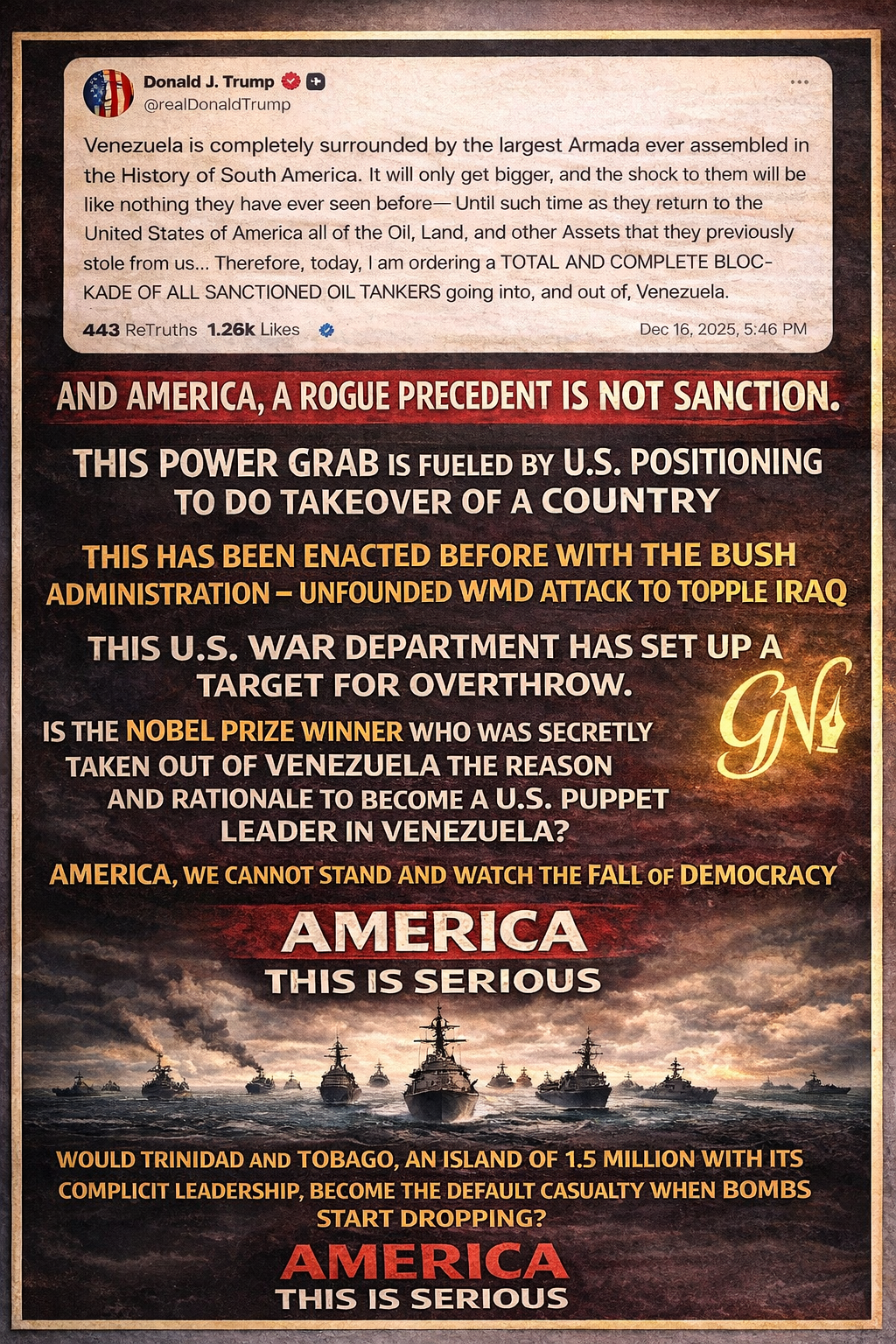
The statement shown in this poster is verified.
It was issued directly from the President of the United States’ official, verified social account.
This is not rumor. This is not commentary.
Check for yourself.
We are being drawn openly and deliberately into a military engagement in Latin America. A declared naval blockade, public threats of force, and the designation of a sovereign government as a terrorist entity are not rhetorical devices. Under international law, these actions signal war.
Who gave America the license?
Who decided that one nation could unilaterally redraw the rules of international order declare blockades, designate sovereign governments as terrorists, and posture military force without a declaration of war, without global consensus, without consequence?
This is not about partisanship.
This is not about personalities.
This is about precedent.
A familiar and dangerous playbook
We have seen this playbook before. We were told threats were imminent. We were told intervention was necessary. We were told democracy would follow. What followed instead were destabilized regions, civilian casualties, and decades-long consequences that outlived the justifications.
When the United States normalizes unilateral escalation, it weakens the very democratic principles it claims to protect. History is unambiguous: when great powers posture, small nations become collateral.
The Caribbean.
Latin America.
Island states without the luxury of distance.
Questions that demand transparency
It has been reported [reported] that a Nobel Prize–winning Venezuelan figure was escorted under U.S. security arrangements to receive her award amid heightened diplomatic tension. The precise nature and purpose of that escort have not been publicly documented in full detail [unconfirmed].
Whether this constituted a routine security measure or a strategic diplomatic signal remains [unconfirmed]. History shows that symbolic legitimacy is often elevated before political transition efforts are openly acknowledged [historical pattern].
At the same time, it is publicly documented [public record] that Trinidad and Tobago has expanded defense and maritime security cooperation with the United States. How far this cooperation extends operationally during periods of escalation remains unclear [unconfirmed].
This is not an accusation. It is an observation of alignment and proximity [public record].
Small island nations do not control escalation once major powers move assets, logistics, and deterrence infrastructure into place. When defense cooperation shifts from diplomacy to operational readiness, civilian populations inherit consequences they did not authorize [historical precedent].
Silence is not restraint.
Silence is consent.
America must pause.
America must ask hard questions.
America must stop normalizing war language as policy.
This is serious.