Voting Influence, Power—and sold for a few pieces of silver
I do not approach this from abstraction, nor from some distant, analytical perch. This is personal. This is the quiet dissonance that has taken root in conversations with friends, within family, across communities where faith once operated as shared sanctuary and now sits as a point of fracture. Because belief is not benign. As we often say—belief can cure, and belief can kill. And what has unfolded within the Catholic and broader Christian electorate is not simply political alignment; it is the consequence of belief shaped, directed, and in many cases, left unexamined.
Let’s talk numbers—because numbers are not innocent. Catholics represent approximately 22–25% of the U.S. electorate, and within that bloc, white Catholics voted in majority alignment with Donald Trump. When extended further to white evangelical and fundamentalist Christians who themselves account for nearly a quarter of the voting population and supported Trump at rates approaching 75–80% the scale becomes unmistakable. This is not marginal. This is not incidental. This is a moral voting bloc of consequence.
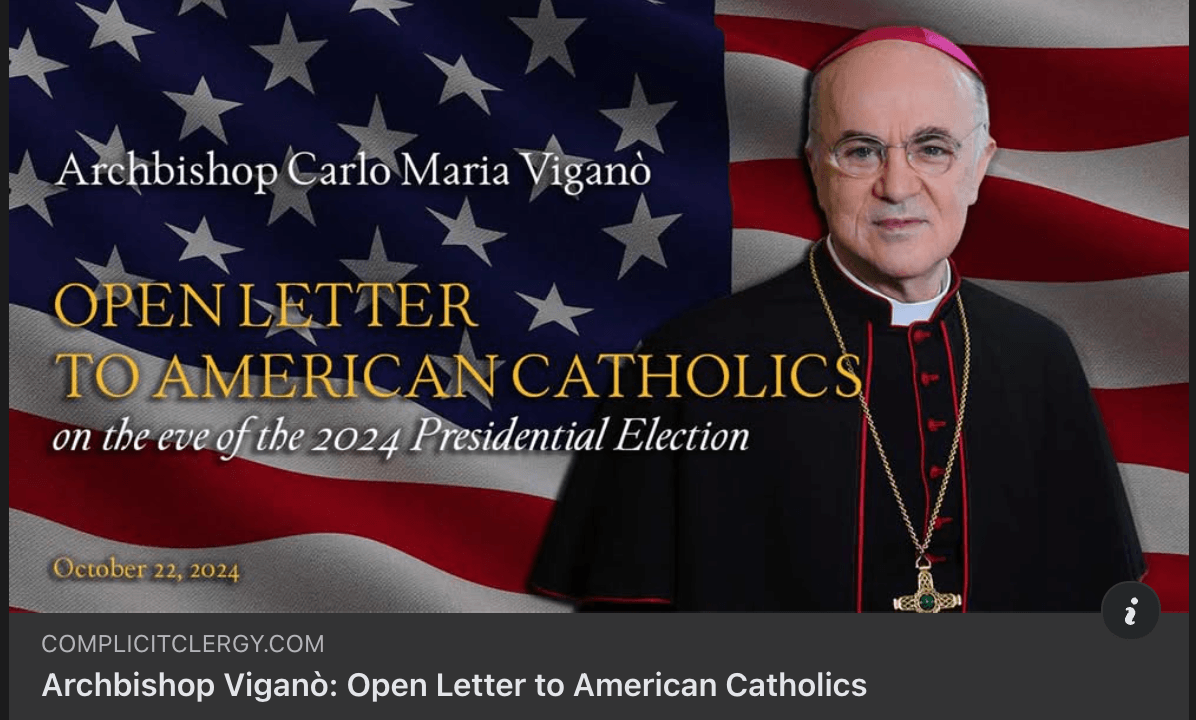
And that bloc did not move in silence. It was shaped, directed, conditioned through language presented not as opinion, but as doctrine. Language declaring that voting otherwise is morally inadmissible, that abstaining is betrayal, that neutrality is alignment with evil (Archbishop Viganò’s open letter to American Catholics). This is not casual rhetoric. This is the language of moral consequence. And when it enters the conscience of believers—those who pray, who receive sacraments, who live within the cadence of faith—it does not pass lightly. It settles. It binds. It directs.
The numbers themselves tell a sobering story. Catholics, comprising roughly a quarter of the American electorate, delivered a decisive share of their vote toward Donald Trump, with white Catholics aligning in clear majority. When extended to white evangelical and fundamentalist Christians voting at rates approaching eighty percent in support—the picture becomes unmistakable. This was not incidental. This was a moral bloc, mobilized with conviction.
And that conviction did not emerge in isolation. It was reinforced explicitly through language that carried the weight of doctrine. In that same widely circulated letter, Catholics were told that voting otherwise was “morally inadmissible,” that abstaining was itself a betrayal, that neutrality was alliance with the enemy language that did not simply persuade, but prescribed. It impacted a doctrine of followers to the point that unexamined, mindless, and ultimately irreparable decision-making was inflicted upon Catholic congregations. That is what the Trump machinery has been strategic and shrewd with.
So what follows cannot be dismissed as mindlessness. It is conditioned belief. And that is precisely why it is so deeply unsettling.
Because the outcome is now visible. A Church-influenced electorate, mobilized in defense of faith, delivers power to a man whose public life reflects everything but the discipline, humility, and moral integrity that faith demands. And now, without hesitation, that same man turns toward the leader of that faith, Pope Leo XIV, with rhetoric that is not merely critical but openly derisive stripped of reverence, absent of restraint, void of even the pretense of sacred regard.
And then, as if to deepen the affront, imagery emerges placing himself in the posture of divine healing. Not servant. Not disciple. But figure. Elevated. Performed.